

In this blog, we’ll explore 7 adaptive teaching strategies that can help tutors better support SEN learners and improve engagement.
If you’ve ever finished a session feeling like nothing quite landed, the student seemed disengaged, the worksheet went untouched, or progress felt impossibly slow, you’re not alone.
Many tutors instinctively know that something needs to change but aren’t sure what. The answer is often adaptive teaching strategies: small, deliberate adjustments that meet learners where they actually are, rather than where we assume they should be.
Whether you work with students with Special Educational Needs (SEN), learners with anxiety, or pupils who’ve simply had inconsistent schooling, these strategies can transform the way you teach and the way your students learn.
What Is Adaptive Teaching, and Why Does It Matter?
Adaptive teaching isn’t about rewriting every lesson from scratch. It’s about being responsive enough to recognise when a student needs a different approach and flexible enough to provide one.
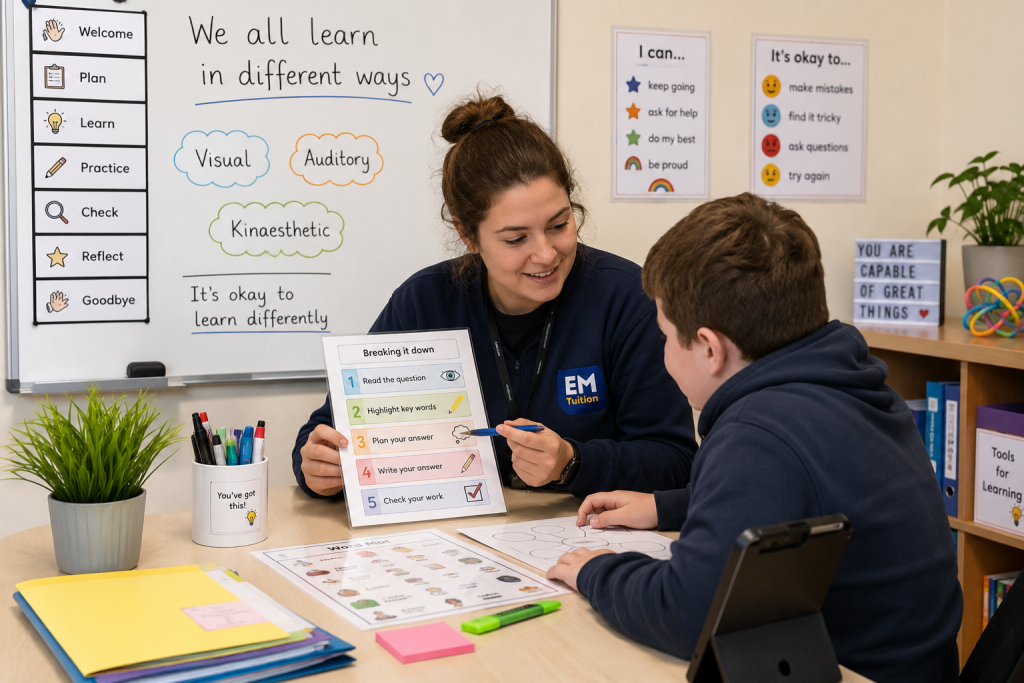
For SEN learners in particular, this isn’t a “nice to have”. It’s often the difference between a student who shuts down and one who starts to believe they’re capable.
It’s also worth saying upfront that adaptive teaching isn’t exclusively for diagnosed SEN students. It benefits anxious learners, EAL students, pupils affected by trauma, those with educational gaps, and even high attainers who need flexible challenge. In short, it’s simply good teaching.
7 Adaptive Teaching Strategies That Actually Work
1. Break Learning Into Smaller Steps
Large tasks can feel overwhelming, particularly for students with working memory or processing difficulties. When a learner sees a full worksheet and shuts down before they’ve started, the problem usually isn’t motivation. It’s that the task feels unmanageable.
Instead of saying “complete the worksheet”, try chunking it:
- Read the first question together
- Highlight the key words
- Complete one example as a pair
- Check for understanding before moving on
This simple shift reduces anxiety, builds momentum, and sets students up to experience success early, which makes everything that follows easier.
2. Reduce Cognitive Overload
Our working memories have limits. When too much information arrives at once, whether that’s dense instructions, busy layouts, or a tutor talking while the student is trying to write, learning breaks down.
Practical ways to reduce cognitive load:
- Simplify your instructions
- Remove unnecessary text from materials
- Give one instruction at a time
- Avoid talking while students are actively working
- Use clean, uncluttered layouts
Sometimes the most powerful thing you can do is slow down and strip back.
3. Use Visual Supports
For many learners, particularly those with dyslexia, autism, or language processing difficulties, seeing information is significantly easier than processing lengthy verbal explanations.
Visual supports worth incorporating include:
- Timelines and diagrams
- Colour coding
- Graphic organisers
- Visual checklists
- Worked examples left on the desk for reference
- Symbols or images alongside text
These aren’t simply scaffolds to remove later. For many students, they’re the most effective way to access and retain information.
4. Allow Processing Time
This one is deceptively simple and surprisingly hard to do in practice.
Some students need longer to think, organise their thoughts, or process language. As tutors, silence can feel uncomfortable. The urge to rephrase, prompt, or fill the gap is natural. However, rushing to fill silence can prevent learners from engaging independently.
Try waiting an extra 5 to 10 seconds after asking a question. You may be surprised by what emerges when students are given genuine space to think.
5. Build Predictability and Routine
Anxious learners, and many SEN students, thrive on predictability. When the structure of a session is unclear or inconsistent, cognitive energy goes towards managing uncertainty rather than learning.
Simple routines that make a real difference:
- Start each session the same way
- Share lesson objectives clearly at the beginning
- Use consistent language and phrasing
- Give warnings before transitions
- End sessions with a brief reflection or success review
Predictability creates psychological safety. And psychological safety is where learning happens.
6. Offer Flexible Ways to Respond
Not every student demonstrates understanding best through writing. When we default to written tasks, we risk assessing handwriting speed, processing ability, or working memory rather than actual understanding.
Alternatives worth offering:
- Verbal responses
- Mind maps or diagrams
- Matching or multiple-choice activities
- Practical demonstrations
- Technology-assisted responses
- Drawing or sketching ideas
The goal is always to assess understanding, not to inadvertently create barriers to showing it.
7. Prioritise Relationship Before Results
Perhaps the most important strategy of all, and the one least likely to appear in a curriculum framework.
Students learn best when they feel respected, listened to, safe from embarrassment, and genuinely understood as individuals. For many SEN learners, having one consistent adult who believes in them, without condition or pressure, can be life-changing.
Invest in the relationship first. Results tend to follow.
The following adaptive teaching strategies show how small adjustments can make a significant difference for learners with additional needs.
Practical Examples Of Adaptive Teaching Strategies
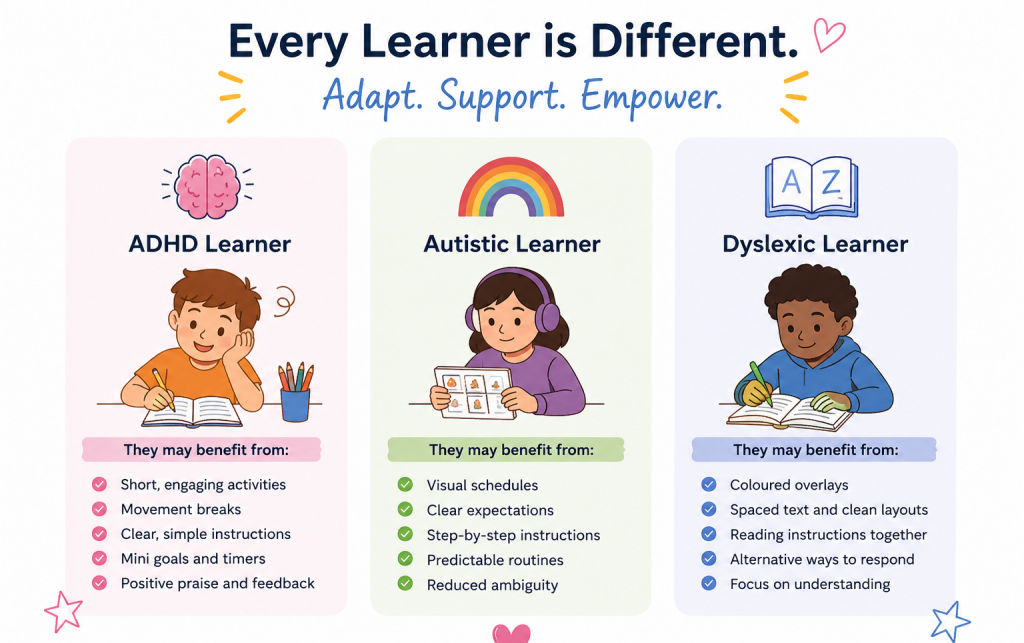
Example 1: Supporting an ADHD Learner
A tutor notices a student struggles to stay seated and loses focus during long explanations.
Instead of repeatedly saying, “Concentrate”, the tutor adapts by:
- Using shorter activities
- Incorporating movement breaks
- Setting mini targets
- Using timers
- Increasing interaction
- Providing immediate praise and feedback
The result? Improved engagement without constant correction.
Example 2: Supporting an Autistic Learner
A student becomes anxious when tasks are unclear.
The tutor introduces:
- A visual lesson schedule
- Clear expectations
- Step-by-step instructions
- Predictable routines
- Reduced ambiguity in questioning
The student becomes calmer, more confident, and increasingly independent.
Example 3: Supporting a Learner with Dyslexia
A pupil struggles with dense written tasks and avoids reading aloud.
The tutor adapts by:
- Using coloured overlays
- Increasing spacing on worksheets
- Reading instructions together
- Allowing verbal responses
- Focusing on understanding rather than spelling accuracy
The learner begins participating more willingly because the barriers are reduced.
Adaptive Teaching Benefits Every Learner
One important point is that adaptive teaching is not only beneficial for students with diagnosed SEN.
Good adaptive practice supports:
- Learners with anxiety
- Students with gaps in education
- EAL learners
- Low-confidence students
- Learners affected by trauma
- Pupils with inconsistent attendance
- High-attaining learners who benefit from flexible challenge
Clear instructions, supportive environments, and varied teaching methods improve learning for everyone.
This is why adaptive teaching should not be viewed as an “extra”. It is simply effective teaching.
A Shift in Mindset Worth Making
The language we use around struggling students matters more than we often realise.
Labels like “lazy”, “disruptive”, or “low ability” are absorbed quickly and can have a lasting impact. Adaptive teaching starts with a different question entirely.
Instead of asking, “What is wrong with this student?”
Ask, “What barrier is this student experiencing right now?”
That shift from frustration to curiosity changes everything about how we teach and how our students experience learning.
Challenges When Using Adaptive Teaching Strategies
Of course, adaptive teaching is not always easy.
Tutors may experience:
- Limited time
- Wide ranges of need
- Behavioural challenges
- Gaps in prior learning
- Emotional dysregulation
- Pressure around outcomes
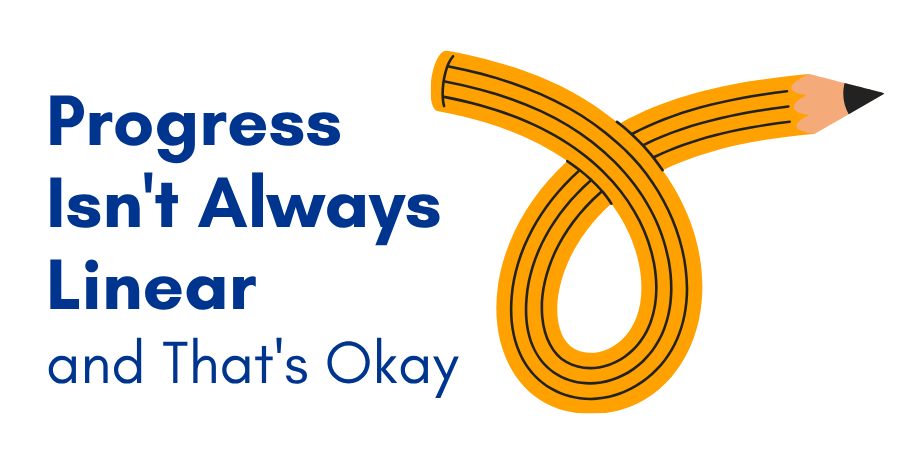
There will be sessions that feel hard. Progress with SEN learners can be slow, non-linear, and sometimes invisible in the short term.
But consider what actually counts as progress:
- A student staying engaged for ten extra minutes
- A learner attempting work independently for the first time
- A pupil attending consistently after long-term school refusal
These wins matter enormously. They’re often the foundation everything else is built on.
Ready to Teach More Adaptively?
Adaptive teaching doesn’t require more time, more resources, or completely different lessons. It requires attention, flexibility, and a genuine belief that every learner, given the right environment, is capable of progress.
A calm explanation. A visual aid. An extra minute to think. A session where mistakes feel safe.
To us, these may seem like small things. To a struggling learner, they can mean everything.
Want more practical strategies for tutoring SEN and complex learners? Get in touch

Written by Tony Maynard
Contracts Manager, EM Tuition
At EM Tuition, the focus is simple: understanding the learner first, and building everything else around that. If you would like to explore how personalised, one-to-one support can help autistic learners feel more confident and engaged, we would be happy to speak with you. Get in touch