

Every April, conversations around autism become more visible. We see more posts, more awareness, more reminders to be inclusive. And while that matters, it often stops short of something deeper, understanding.
In education, that gap is significant. We talk about adapting lessons and supporting autistic learners, but rarely pause to ask a simpler, more important question:
What does this learner actually need from me?
Because the answer is rarely found in a checklist.
A 2026 survey by Ambitious about Autism, reported by The Guardian, found that:
1 in 6 autistic pupils have not attended school at all since the start of the academic year.
Not occasionally. Not sporadically. Entirely.
As Stephen Shore puts it, “When you’ve met one person with autism, you’ve met one person with autism.”
There is no single way to be autistic. One learner may communicate confidently but struggle with unpredictability. Another may prefer minimal verbal interaction but engage deeply through structure. Some may appear to cope well on the surface, only to feel the impact later.
Which means the role of a tutor is not to apply a method, but to understand a person.
What makes the difference
- Predictability and clear structure:
Knowing what to expect, even in a small session reduces anxiety and frees up cognitive space for actual learning. A simple session outline shared at the start can be transformative.
- Explicit communication:
Autistic learners often process language very literally. Idioms, sarcasm, and vague instructions like “do your best” can cause confusion. Clear, direct language builds trust and reduces misunderstanding.
- Time and patience with processing:
Many autistic learners need more time to formulate responses. Silence is not a sign of not knowing, it’s often a sign of deep thinking. Resist the urge to fill it too quickly.
- Interest-led learning where possible:
Connecting content to a learner’s passion areas is a powerful motivational tool, not a distraction. If a learner loves Minecraft, fractions can be taught through resource management. If they love trains, timelines and graphs come alive differently.
- Sensory awareness:
For some autistic learners, environmental factors; lighting, noise, the texture of worksheets, even how a tutor is sitting, can significantly affect focus. Being open to adjusting the environment shows respect for the whole person.
- Being taken seriously:
Autistic young people are often highly perceptive. They notice when adults are performing patience rather than genuinely engaging. Authenticity matters deeply.
When autistic learners describe what helps them engage, their answers are often simple. Not easy, but simple. They speak about knowing what to expect.
About clarity in communication. About being given time to think without pressure.
They speak about environments that do not overwhelm them, and interactions that feel genuine rather than forced. They speak about being allowed to learn in ways that make sense to them.
Not rushed. Not reshaped. Not constantly corrected. Just understood.
“If a child can’t learn the way we teach, maybe we should teach the way they learn.”-Ignacio Estrada
The Quiet Effort Behind “Coping”
There are learners who appear settled, engaged, even successful. They follow instructions, they complete tasks, they do not draw attention to themselves. But sometimes, what looks like coping is actually effort.
Effort to mask confusion. Effort to manage discomfort. Effort to behave in a way that feels acceptable.
That effort is not always visible. But it is real. And when most of a learner’s energy is spent on managing the environment, there is very little left for learning itself.
Over time, that imbalance can lead to fatigue, anxiety, or complete withdrawal. Tutors who only see the surface and push ahead because “they seemed fine” can inadvertently contribute to burnout.
The antidote? Create an environment where there is genuinely no need to mask. That means accepting stimming, not demanding eye contact, allowing silence, and making it clear that being yourself is not only acceptable, it’s welcome.
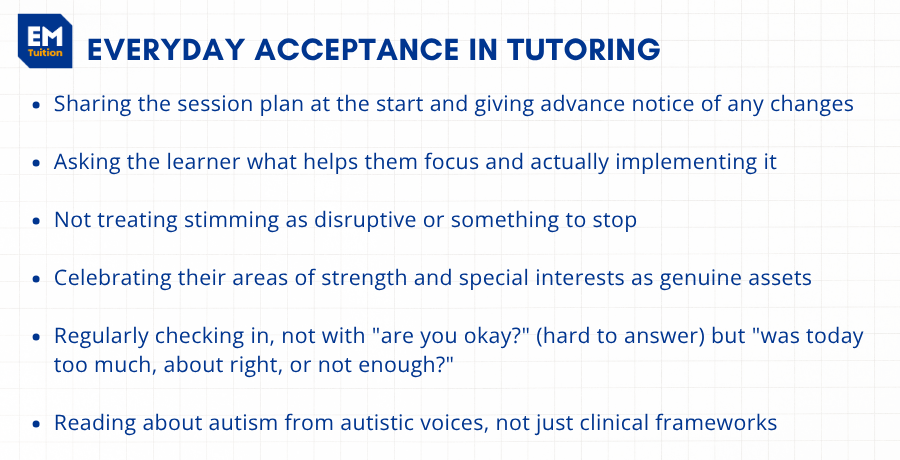
What Acceptance Looks Like
Acceptance, in a learning context, is not about lowering expectations.
It is about removing unnecessary barriers. It looks like giving clarity before expecting output. It can be allowing silence without rushing to fill it or noticing when something is not working, and being willing to adjust.
It means recognising that engagement does not always look the same and that progress is not always immediate or visible. Most importantly, it means meeting the learner where they are, rather than expecting them to meet a predefined idea of how learning should look.
A Shift in Perspective
Perhaps the most meaningful shift is this:
Moving away from asking “How do I support this learner?”
And towards “What does this learner need in order to feel able to learn?”
The difference is subtle, but it changes everything because one assumes a method, the other requires understanding.
If more autistic learners are stepping away from education, the question is not whether they are capable. It is whether the environments around them are. And whether we are willing to adapt those environments, not just in structure, but in mindset. Understanding is not an additional step in education. For many learners, it is the starting point.
This Autism Acceptance Week, we’d encourage every educator, tutor, and parent to ask not “how do I help my autistic student?” but “how well do I actually know this person?” The answer to that question is where real progress begins.
At EM Tuition, the focus is simple: understanding the learner first, and building everything else around that. (Read our recent case study)
If you would like to explore how personalised, one-to-one support can help autistic learners feel more confident and engaged, we would be happy to speak with you.